Why Bangladesh and Myanmar Need Each Other


Dr. Sarder A. Haider
Bangladesh and Myanmar are neighbors not by choice, but by geography, history, and strategic necessity. The two countries share borders, rivers, maritime space, memories of older social contact, and a difficult set of present-day problems. For Bangladesh, Myanmar is not simply a troubled eastern neighbor; it is also the only direct land bridge to Southeast Asia. For Myanmar, Bangladesh is not merely a western border state; it is a large and growing market, a gateway to South Asia, and a country whose cooperation is essential for managing Rakhine, border stability, humanitarian issues, and regional legitimacy.
Yet, despite this unavoidable closeness, Bangladesh-Myanmar relations have remained narrow, crisis-driven, and full of suspicion. The Rohingya crisis has understandably dominated Bangladesh’s national attention. More than one million Rohingya refugees now live in Bangladesh, mostly in Cox’s Bazar, creating one of the world’s largest and most protracted refugee situations. This has placed enormous pressure on Bangladesh’s society, economy, environment, security system, and diplomacy. However, the difficult truth is that the Rohingya crisis cannot be solved by distance alone. It requires pressure, diplomacy, international support, and direct engagement with Myanmar.
The central argument of this article is simple; Bangladesh and Myanmar need each other because many of their problems are shared, and many of their future opportunities are connected. Engagement does not mean surrender. Dialogue does not mean compromise on justice. Cooperation does not mean forgetting the Rohingya crisis. Rather, a mature Bangladesh policy should combine firmness on national interest with practical engagement. Bangladesh should remain principled on Rohingya repatriation, but it should also reopen channels of communication with Myanmar through military, diplomatic, economic, academic, cultural, and people-to-people exchanges.
An old relationship buried under present mistrust
Bangladesh-Myanmar relations did not begin with the Rohingya crisis. Long before modern borders hardened political identities, the Bay of Bengal connected people, trade, religion, labour, and culture. Bengal and Burma were part of a wider eastern Indian Ocean world. Chittagong, Cox’s Bazar, Arakan, Rangoon, and other coastal spaces were historically linked through mobility and commerce. People from Bengal travelled to Burma for work, business, clerical jobs, port-related activities, and agricultural opportunities, especially during the colonial period. Historical studies on migration from Bengal to Arakan and Burma show that movement across this frontier was not unusual; it was part of a larger pattern of labour and economic mobility under British rule.
This historical memory matters because it reminds us that the present border of suspicion is not the only possible relationship between the two societies. Many people from Bengal once saw Burma as a place of economic opportunity. Rangoon was familiar to many Bengali families. Trade, employment, and migration created a form of social knowledge between the two sides. Even today, old memories of Burma remain visible in Bengali literature, family stories, and regional history. A recent cultural reflection in The Daily Star also noted that Bengal and Burma had socio-cultural and economic exchanges long before colonial rule formally shaped the region.
After the independence of Bangladesh, diplomatic relations with Myanmar were established early. Bangladesh’s Embassy in Yangon states that Bangladesh opened its embassy there on 1 April 1972, shortly after independence. This means that formal relations between the two countries began with hope, not hostility. The problem is that this promise was never fully developed into a deep neighborhood partnership.
How distance replaced familiarity
The relationship gradually became distant for several reasons. Myanmar’s long military rule, internal conflict, ethnic insurgencies, and international isolation reduced normal political, commercial, and social interaction. Bangladesh, on the other hand, developed stronger relations with South Asia, the Middle East, China, Japan, Europe, and the United States, but its eastern neighborhood remained underexplored. The border between Bangladesh and Myanmar became more associated with refugees, narcotics, smuggling, insecurity, and military tension than with trade, tourism, and connectivity.
The Rohingya issue made this mistrust much deeper. Bangladesh faced earlier Rohingya influxes before 2017, but the mass displacement that began in August 2017 changed the entire emotional and strategic environment. Bangladesh opened its border and gave shelter to a persecuted population, but the burden has become long-term. The camps in Cox’s Bazar are overcrowded, aid-dependent, and exposed to security, environmental, social, and humanitarian pressures. UNHCR describes the Rohingya situation in Bangladesh as one of the largest protracted refugee situations in the world.
This crisis cannot be minimized. Bangladesh has legitimate grievances. The Rohingya must be able to return to Myanmar in safety, dignity, and with a sustainable future. At the same time, Bangladesh must ask a hard policy question; has diplomatic distance helped resolve the crisis? The answer is not encouraging. International pressure remains necessary, but without communication with Myanmar’s power centers, administrative actors, border authorities, military institutions, local communities, and future political forces, repatriation will remain highly uncertain.
In April 2025, Reuters reported that Myanmar had confirmed 180,000 Rohingya from a list submitted by Bangladesh as eligible for return, although many verification and rights-related questions remained unresolved. This shows that even limited progress requires some form of direct communication. The problem is not engagement itself; the problem is weak, unstructured, and crisis-only engagement.
Why Bangladesh needs Myanmar
Bangladesh needs Myanmar for at least five major reasons; geography, ASEAN connectivity, security, trade, and Rohingya repatriation.
First, Myanmar is Bangladesh’s only direct land connection to Southeast Asia. Bangladesh has long spoken about a “Look East” vision, but this vision cannot become practical if relations with Myanmar remain frozen. ASEAN’s official list confirms that Myanmar has been a member of ASEAN since 1997. Therefore, any serious Bangladeshi aspiration to deepen engagement with ASEAN must consider Myanmar’s geographical and political position. Bangladesh has sought support for becoming an ASEAN Sectoral Dialogue Partner, and this ambition will be stronger if Dhaka can show that it is capable of constructive relations with Southeast Asia’s western gateway.
Second, Bangladesh needs a stable eastern border. The Bangladesh-Myanmar frontier is affected by conflict in Rakhine, armed group activity, narcotics flows, human trafficking, illegal trade, and refugee movement. These problems cannot be managed by one country alone. When communication is weak, misunderstanding increases. When misunderstanding increases, small incidents can become serious crises. Regular contact between border forces, local administrators, military officers, diplomats, and technical agencies can reduce risk.
Third, Myanmar matters for Bangladesh’s economy. Although current trade remains limited and often disrupted by conflict, the potential is real. Border trade through Teknaf and Maungdaw has historically been important, and recent reports indicate attempts to reopen or resume trade despite instability in Rakhine. Bangladesh could export pharmaceuticals, garments, processed foods, leather goods, cement, construction materials, light engineering products, and consumer goods. Myanmar could export agricultural products, fishery items, timber under legal frameworks, minerals, and other raw materials. Trade alone will not solve political problems, but trade can create constituencies for peace.
Fourth, Myanmar is important for Bangladesh’s Bay of Bengal strategy. The Bay of Bengal is no longer a quiet maritime zone. It is connected to energy, ports, blue economy, fisheries, climate vulnerability, maritime security, and great-power competition. Bangladesh and Myanmar share maritime proximity and can cooperate in disaster management, search and rescue, fisheries regulation, environmental protection, and maritime confidence-building.
Fifth, Myanmar is indispensable for resolving the Rohingya crisis. Bangladesh may seek support from the UN, ASEAN, OIC, China, India, Japan, the United States, and the European Union, but the country of origin remains Myanmar. Repatriation cannot be implemented without some form of understanding with Myanmar’s relevant authorities and local actors in Rakhine. Therefore, Bangladesh must keep the Rohingya issue central, but it should not reduce the entire relationship to public condemnation only. A door must remain open.
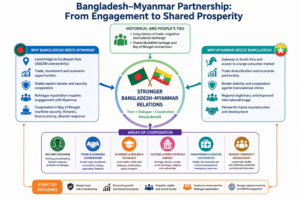
Why Myanmar needs Bangladesh
The argument must not be one-sided. Myanmar also needs Bangladesh.
Bangladesh is a large neighboring market with more than 170 million people. It has a growing economy, a strong garment sector, expanding pharmaceutical capacity, a developing infrastructure base, and increasing relevance in regional diplomacy. For Myanmar, Bangladesh can serve as a western gateway to South Asia and the Bay of Bengal. Better relations with Bangladesh could reduce Myanmar’s overdependence on a narrow set of external partners and open new economic options in the long term.
Myanmar also needs Bangladesh for border stability. Rakhine State is one of the most sensitive areas in Myanmar’s internal conflict. The spread of conflict, refugee movement, smuggling, and armed group activity near the Bangladesh border is not only a Bangladeshi concern; it is also a Myanmar concern. No responsible state can permanently ignore instability on its border.
Myanmar also needs regional legitimacy. Since the 2021 coup, Myanmar has faced deep international criticism and exclusion from full ASEAN political participation. Reuters reported in February 2026 that Thailand was trying to act as a bridge between Myanmar and ASEAN, reflecting the wider regional concern that Myanmar’s internal crisis has become a regional problem. If Myanmar wants to reduce isolation, practical cooperation with Bangladesh can become one useful channel.
Finally, Myanmar will need neighbors for any future reconstruction. Whether Myanmar moves toward political settlement soon or remains unstable for years, its long-term recovery will require trade, infrastructure, public health cooperation, education, border management, and regional economic integration. Bangladesh can be part of that future.
Table-1: Why Bangladesh and Myanmar Needs Each Other
| Area | Why Bangladesh Needs Myanmar | Why Myanmar Needs Bangladesh |
| Geography | Myanmar is Bangladesh’s only direct land bridge to Southeast Asia. | Bangladesh is Myanmar’s western gateway to South Asia and the Bay of Bengal. |
| Economy | Myanmar can offer trade, border commerce, natural resources, fisheries, and access to ASEAN markets. | Bangladesh offers a large consumer market, pharmaceuticals, garments, leather goods, construction materials, and food products. |
| Security | Bangladesh needs a stable eastern border to control narcotics, arms trafficking, insurgency movement, and refugee pressure. | Myanmar also needs border stability, especially in Rakhine and Chin areas. |
| Rohingya Issue | Repatriation is impossible without communication with Myanmar. | Constructive engagement with Bangladesh can reduce international pressure and improve Myanmar’s regional image. |
| ASEAN Linkage | Better ties with Myanmar can strengthen Bangladesh’s ASEAN engagement. | Bangladesh can help Myanmar connect more practically with South Asia. |
| Bay of Bengal | Myanmar is important for maritime security, blue economy, fisheries, and disaster cooperation. | Bangladesh can be a partner in maritime trade, disaster response, and regional connectivity. |
| Regional Diplomacy | Myanmar gives Bangladesh a stronger eastern strategic outlook. | Bangladesh gives Myanmar an opportunity to diversify regional relationships. |
Military exchange as a practical starting point
Bangladesh should think creatively. One practical starting point could be limited, carefully designed, and transparent military-to-military exchange. This does not mean supporting any controversial political action inside Myanmar. It means building professional channels with an institution that has historically remained central to Myanmar’s state, border policy, security decisions, and Rohingya-related calculations.
Bangladesh may consider offering selected vacancies for Myanmar officers in carefully chosen professional courses of the Bangladesh Armed Forces. These should not be combat-oriented or politically sensitive courses. The focus should be peacekeeping, humanitarian assistance, disaster response, military medicine, engineering, logistics, border management, language, staff-level communication, and civil-military coordination. Bangladesh has strong experience in UN peacekeeping and can use this professional reputation as a soft-power instrument.
India has already demonstrated the utility of such engagement. In May 2026, India’s Centre for United Nations Peacekeeping began a two-week UN Peacekeeping Operations course for 30 Myanmar officers in Naypyidaw, conducted by an Indian training team. Myanmar International TV also reported that the course involved Myanmar officers from the Army, Navy, and Air Force and was jointly conducted with the Indian Army. Bangladesh should observe this development carefully. If India can engage Myanmar’s officers through peacekeeping training, Bangladesh can also design its own professional and principled engagement model.
For Bangladesh, such exchange would have several advantages. It would create personal familiarity among officers. It would reduce misperception. It would provide Bangladesh with better understanding of Myanmar’s military thinking. It would create communication channels during border tension. It could also expose Myanmar officers to Bangladesh’s peacekeeping culture, humanitarian outlook, and professional military education.
However, the design must be careful. Bangladesh should begin with small numbers, non-offensive courses, and clear diplomatic framing. The message should be: this is not political endorsement; this is professional engagement for regional stability, humanitarian responsibility, and confidence-building.
Beyond military: a wider engagement framework
Military exchange may be an entry point, but it cannot be the whole policy. Bangladesh and Myanmar need a broader engagement framework.
First, academic and research exchange should be encouraged. Bangladesh needs more serious Myanmar studies. Our universities, think tanks, military institutions, and research centers should study Myanmar’s politics, ethnic armed organizations, Rakhine society, border economy, Buddhist-Muslim relations, narcotics networks, maritime issues, and ASEAN politics. Similarly, Myanmar scholars and professionals should understand Bangladesh beyond the refugee question. Seminars, joint workshops, translation projects, and policy dialogues can reduce ignorance on both sides.
Second, economic engagement should be revived. Chambers of commerce, border traders, port authorities, shipping agencies, and business associations should be involved. The Teknaf-Maungdaw trade route should not remain hostage to uncertainty forever. The resumption of border trade, even in limited form, shows that economic links still have practical value.
Third, cultural and historical exchange should be promoted. Bangladesh and Myanmar share Buddhist heritage, Islamic connections in coastal history, colonial memories, maritime trade routes, and literary references. Cultural diplomacy can humanize a relationship that has become too security-heavy.
Fourth, border community engagement is necessary. People living near borders often suffer first when relations deteriorate. Teknaf, Cox’s Bazar, Bandarban, Maungdaw, Buthidaung, and surrounding areas need regulated trade, public health cooperation, anti-trafficking mechanisms, and disaster response arrangements. Local-level communication can sometimes solve problems before national-level diplomacy becomes involved.
Fifth, humanitarian and disaster cooperation should be prioritized. Cyclones, floods, disease outbreaks, maritime accidents, and displacement affect both countries. Cooperation in these areas is less politically sensitive and can create trust gradually.
Table 2: Bangladesh and Myanmar Engagement Framework
|
Level of Engagement |
Possible Areas | Expected Benefits |
Necessary Safeguards |
| Military-to-Military | Peacekeeping, disaster response, military medicine, logistics, staff-level dialogue, language courses | Builds confidence, reduces misunderstanding, creates emergency communication channels | Should remain non-offensive, transparent, and professionally framed |
| Diplomatic | Foreign ministry dialogue, border meetings, technical committees | Keeps communication open during crises | Rohingya repatriation must remain central |
| Economic | Border trade, shipping, agriculture, fisheries, pharmaceuticals, leather goods, garments | Creates mutual economic interest and reduces hostility | Trade must be legal, regulated, and monitored |
| Academic and Research | Joint seminars, Myanmar studies, borderland research, think-tank dialogue | Improves understanding of each other’s society, politics, and security concerns | Should avoid propaganda and remain research-based |
| Cultural | Heritage, literature, religious history, tourism, people-to-people contact | Restores historical memory and social familiarity | Should be inclusive and non-political |
| Humanitarian and Disaster Cooperation | Cyclone response, public health, maritime rescue, humanitarian coordination | Builds trust through practical cooperation | Must not weaken Bangladesh’s humanitarian position on Rohingya rights |
| Border Community Engagement | Local trade, health cooperation, anti-trafficking, local administration contact | Reduces border tension and improves livelihoods | Requires strict security monitoring |
Engagement with safeguards
There are risks. Bangladesh must not appear weak on the Rohingya issue. It must not allow engagement to be used as propaganda by any actor in Myanmar. It must not ignore human rights concerns. It must not undermine international efforts for accountability. Therefore, engagement must be principled, transparent, and linked to Bangladesh’s national interest.
Four safeguards are necessary.
First, engagement must not mean endorsement. Bangladesh can talk to Myanmar without approving all actions of Myanmar’s authorities.
Second, cooperation must not silence Bangladesh’s demand for safe, voluntary, dignified, and sustainable Rohingya repatriation.
Third, any military exchange should focus on professional, humanitarian, peacekeeping, and confidence-building themes, not offensive operations.
Fourth, Bangladesh should coordinate its approach with ASEAN, China, India, Japan, the UN, and other relevant actors where useful, while preserving its own independent national interest.
A practical roadmap
Bangladesh should adopt a phased approach.
In the first phase, Dhaka should revive structured official dialogue with Myanmar through foreign ministry channels, border guard meetings, defense contacts, and technical committees. These meetings should not wait for a crisis.
In the second phase, Bangladesh should identify low-politics areas; disaster management, public health, fisheries, agriculture, border trade, academic exchange, and anti-trafficking cooperation.
In the third phase, Bangladesh may offer limited training seats for Myanmar officers in peacekeeping, logistics, medical, disaster response, staff communication, and language courses.
In the fourth phase, Bangladesh should promote economic connectivity. Border trade, shipping links, port cooperation, and future road connectivity should be studied seriously. The goal should be realistic, not romantic.
In the fifth phase, Bangladesh should keep Rohingya repatriation at the center of diplomatic engagement. Every channel should reinforce Bangladesh’s core message: the Rohingya must return to Myanmar safely, voluntarily, and with dignity.
In the sixth phase, Bangladesh should connect its Myanmar policy with its ASEAN ambition. Better Bangladesh-Myanmar relations can strengthen Bangladesh’s claim that it is not only a South Asian country, but also a natural partner of Southeast Asia.
Conclusion: Neighbors must talk
Bangladesh and Myanmar do not need to agree on everything before they begin talking again. In fact, they need to talk precisely because they disagree on many things. Geography has placed the two countries side by side. History has connected them. Crisis has separated them. Strategy now demands that they rediscover the value of engagement.
The Rohingya crisis remains the most painful issue between the two countries. Bangladesh must never abandon its principled position on repatriation, justice, and human dignity. But Bangladesh must also recognize that permanent silence or emotional distance will not solve the problem. A stronger policy would combine pressure with contact, principle with pragmatism, and national interest with regional imagination.
Military exchange can be a useful first step because security institutions matter in Myanmar. But the larger goal must be broader; economic cooperation, academic understanding, cultural rediscovery, border stability, ASEAN connectivity, and humanitarian problem-solving.
Bangladesh and Myanmar need each other because they are not distant states. They are neighbors with shared risks and shared possibilities. If they remain trapped in suspicion, both will lose opportunities. If they rebuild trust carefully, both can benefit.
The time has come to reopen the Bangladesh-Myanmar door, not by forgetting the past, but by building a more useful future.
For More Info Click Here.
Follow Our Facebook Page From Here.
Subscribe Our Youtube Channel quickly.