Remembering Zhu Rongji: A Great Chinese Leader and Friend of Bangladesh


Lt Col (Retd) Md Shahadat Hossain
The passing of former Chinese Premier Zhu Rongji has brought a deep personal sadness to me. China has lost a great leader, and the world has lost one of the most influential statesmen of modern China. Bangladesh, too, has lost a great Chinese friend—one who personally contributed to deepening Bangladesh-China relations at an important stage of their development.
Zhu Rongji passed away in Beijing on August 12, 2026. He served as Premier of the State Council from 1998 to 2003 and was a central figure in China’s reform and opening-up. He played an important role in strengthening China’s economic and financial systems, reforming state-owned enterprises, controlling inflation, expanding China’s engagement with the global economy and guiding the negotiations that culminated in China’s accession to the World Trade Organization in 2001.
Those achievements will rightly be remembered by historians and the world. I want to remember him somewhat differently—not through statistics or official communiqués, but through moments I personally witnessed while serving as a Chinese-Bangla-English interpreter for Bangladeshi leaders.
I was fortunate to interpret for Premier Zhu Rongji on several occasions in Bangladesh and China. This gave me an unusual opportunity to observe a great statesman at close range—not as a historian looking back at him, but as an interpreter standing beside him and listening to him speak.
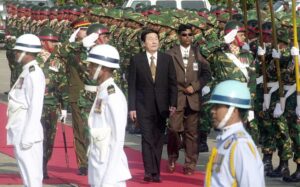
His January 2002 visit to Bangladesh remains particularly vivid in my memory. Zhu visited Dhaka from January 11 to 13, 2002, at a significant moment in bilateral relations. During the visit, he met Prime Minister Khaleda Zia, President A.Q.M. Badruddoza Choudhury, Speaker Jamiruddin Sircar, Foreign Minister M. Morshed Khan and other senior Bangladeshi leaders. He also met Sheikh Hasina, then Leader of the Opposition and the leader of the Awami League. The official Chinese record confirms his January 11 talks with Prime Minister Khaleda Zia and his January 12 meeting with President Badruddoza Choudhury.
I will not repeat here the formal discussions between the two governments. Those are properly documented in the records of both countries. Instead, I want to share a few personal memories that have remained with me for nearly a quarter of a century.

At a state banquet in Dhaka, Prime Minister Khaleda Zia was discussing with Premier Zhu how Bangladesh could reduce its trade deficit with China. Zhu explained several possibilities. One particular point stayed with me: Bangladesh should consider producing goods suited to the tastes and needs of Chinese consumers. If Bangladesh could produce products that ordinary Chinese people wanted to buy, China would naturally import more from Bangladesh.
I found that observation remarkably practical. It was not simply a diplomatic response to a trade imbalance; it was an economic lesson. Instead of looking only at what Bangladesh wanted to sell, Bangladesh should understand what Chinese consumers wanted to buy and develop competitive products accordingly.
I have remembered that advice for years and have repeated its essence at seminars whenever Bangladesh-China trade imbalance has been discussed.
Another memory remains particularly striking to me.
At a banquet at Bangabhaban, President A.Q.M. Badruddoza Choudhury, a physician by profession, began discussing Chinese medicine with Premier Zhu. What surprised me was not simply that Zhu could participate in the conversation, but the breadth and confidence with which he responded. The discussion continued for much of the dinner, with Zhu engaging the President on medical treatment and Chinese medicine with remarkable familiarity.
I knew that Zhu’s formal academic background was electrical engineering at Tsinghua University. Yet that evening I saw another side of him: an extraordinary ability to understand and discuss subjects far beyond his formal field of study.
That quality repeatedly impressed me.
While interpreting for him on different occasions, I noticed that Zhu often spoke apparently from memory and without depending heavily on prepared text. Yet his responses were comprehensive and remarkably relevant. Whether this came from his own extraordinary preparation, his experience or thorough briefings by his staff, I cannot say. But to me it demonstrated a leader who took his responsibilities extremely seriously.
His manner was firm, but his personal interaction could be remarkably gentle.
One of my most unforgettable memories is connected with the Bangladesh-China Friendship Conference Centre. During his January 2002 visit, Premier Zhu and Prime Minister Khaleda Zia participated in the handover ceremony of the Chinese-built centre, which became a tangible symbol of friendship between the two countries.
I remember standing beside Premier Zhu and his wife, Lao An, on the small red-carpeted stage at the front of the centre during the unveiling. I wanted to remain close enough to hear him clearly.
In a low voice, he said in Chinese words to the effect that this was not merely a convention hall, but also a bridge of friendship between China and Bangladesh.
Those words have stayed with me.
Then came another moment that I will never forget.
As Premier Zhu was departing Bangladesh, I was the last Bangladeshi person to speak directly with him. I was conveying Prime Minister Khaleda Zia’s wishes for his good health and safe return to China.
He replied gently in Chinese:
“你是一个中孟桥 – ni shi yi ge zhong meng qiao”
“You are a China-Bangladesh bridge.”
At that moment I was simply doing my duty as an interpreter. I could not have imagined that those few words would remain in my mind for the rest of my life.
Today, after his passing, they have acquired an entirely different meaning.
As an official interpreter, I could not take photographs myself while performing my duties. Over the years, however, I have found many photographs and video images of those occasions in newspapers and electronic media. They now seem much more valuable to me than ordinary photographs. They preserve a period of history—and people who are no longer with us.
In recent times, I often found myself remembering those days because so many of the Bangladeshi leaders with whom I interpreted for Premier Zhu are also gone. Prime Minister Khaleda Zia, President Badruddoza Choudhury and Speaker Jamiruddin Sircar have all passed away. When I heard of Zhu’s death, memories of those people and those occasions began flashing through my mind like diamonds.
Zhu’s connection with Bangladesh did not end with his Dhaka visit. In December 2002, Prime Minister Khaleda Zia made an official visit to China and met Premier Zhu in Beijing. I as an official interpreter of Bangladeshi Prime Minister also had the opportunity to be part of that delegation for 5 days state visit to China and interpreted between both. Their reciprocal visits in the same year represented an important period of high-level engagement between the two countries.
Zhu’s engagement with Bangladesh also extended beyond the government of the day. His meeting with Sheikh Hasina during his January 2002 Dhaka visit is another reminder that his interaction with Bangladesh encompassed leaders across the political spectrum.
The relationship he helped deepen continued through successive Bangladeshi and Chinese leaderships.
That continuity has now reached a new stage.
Prime Minister Tarique Rahman, son of the late Prime Minister Khaleda Zia, visited China from June 22 to 26, 2026. On June 26, he met President Xi Jinping at the Great Hall of the People in Beijing. The two leaders jointly announced the decision to build a China-Bangladesh community with a shared future in the new era, elevating bilateral relations to a higher level. The same visit also included meetings with Premier Li Qiang and Zhao Leji, Chairman of the Standing Committee of the National People’s Congress.
For me, this development represents continuity rather than a break with the past.
The relationship that leaders such as Zhu Rongji helped deepen through political trust, economic cooperation, trade discussions, cultural exchanges and practical projects has continued to evolve through successive generations. Today, it has entered a new stage described by both countries as building a community with a shared future in the new era.
Zhu Rongji was therefore not simply a former Chinese Premier who once visited Bangladesh. He was a leader who personally engaged with Bangladesh at a formative stage of the relationship and helped give practical expression to the friendship between the two peoples.
I cannot claim to speak for every Bangladeshi. But I believe many Bangladeshis who knew of his contribution, particularly those who interacted with him or witnessed his visit, will share my sense of loss.
He was not my relative. He was not a Bangladeshi. I did not know him socially. I was simply a Bangladeshi interpreter fortunate enough to stand beside him during several moments of history.
Yet my eyes became wet when I heard that he was gone.
Perhaps that is one measure of great leadership: its influence can reach people who are neither citizens nor relatives, and memories of a leader’s words can remain alive decades later.
I will remember Zhu Rongji as the great Chinese Premier who helped guide China through a historic period of reform and opening-up, but also as the gentle man whose words once made a Bangladeshi interpreter feel that his small professional duty could contribute to something much larger.
For More Info Click Here.
Follow Our Facebook Page From Here.
Subscribe Our Youtube Channel quickly.
“You are a China-Bangladesh bridge.”
Today, Premier Zhu Rongji is no longer with us.
But the bridge remains.
May his memory remain a blessing to the people of China and Bangladesh. May his contribution to friendship and cooperation between our two countries be remembered with respect. And may the bridge he helped strengthen continue to carry the peoples of China and Bangladesh toward a more peaceful, prosperous and shared future.
Farewell, Premier Zhu Rongji.
Your words remain with me.
Adjunct Professor Lt Col (Retd) Md Shahadat Hossain, psc, MBA, MDS, Graduate in Chinese Language, Beijing Language and Culture University (BLCU), Adjunct Professor, Institute of Professional Language, Bangladesh Maritime University, Chinese–Bangla–English Interpreter,
Researcher and Writer on China-Bangladesh Relations, Author of Chinese Language Text Books, General Secretary, We Speak Chinese Club Bangladesh Limited (WSCC), Recipient of China Bangladesh Friendship Award 2023.