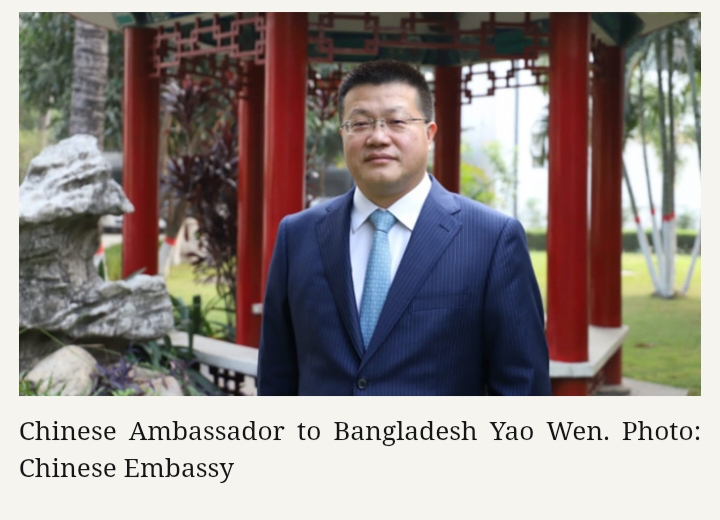
The Dynamic Yao Wen: A Visible Face of China–Bangladesh Relations

Lt Col (Retd) Md Shahadat Hossain
A Diplomat in Constant Motion
Having been continuously involved with the promotion of Chinese language education and China–Bangladesh relations since 1988, I have had opportunities to interact with successive Chinese ambassadors to Bangladesh at seminars, diplomatic programmes and other engagements. Each has made significant contributions to bilateral friendship. Yet my personal observation of H.E. Mr. Yao Wen has left a particularly strong impression.
I have interacted with him directly at the Bangladesh Institute of International and Strategic Studies (BIISS), the Chinese Embassy, North South University, the University of Dhaka, the National Skill Development Authority and other programmes concerning China–Bangladesh cooperation. I have consistently found him lively, accessible, punctual, well-prepared and intensely focused on the purpose of each engagement.
In today’s Dhaka, simply reaching a scheduled programme on time can itself be an achievement. Yao Wen, however, has maintained a remarkably active public schedule despite the city’s very busy traffic. His frequent meetings, seminars, university visits, media engagements and interactions with officials, political leaders, businesspeople and civil-society representatives give the impression of a diplomat who is rarely standing still.
Experience Behind the Energy
Yao Wen became China’s 16th Ambassador to Bangladesh, arriving in Dhaka on 28 December 2022. The Chinese Embassy records that he was born in August 1973 and holds a master’s degree in law. His earlier diplomatic career included assignments in the Chinese Foreign Ministry and Chinese missions in Indonesia, Thailand and Pakistan, as well as senior responsibilities in the Ministry’s Asian Affairs Department and Department of North American and Oceanian Affairs.
That regional and policy experience is visible in his public communication. In seminars and interviews, he generally speaks with current figures, developments and policy details at his fingertips. Whether the subject is trade, infrastructure, education, healthcare, the Rohingya issue, regional connectivity or international affairs, he tends to provide audiences with a broader context rather than merely repeating diplomatic formulas.
His early engagements illustrate this approach. Within months of arriving, he visited Dhaka University and North South University to discuss higher education, Chinese-language learning and youth exchanges. He also addressed Bangladesh’s Foreign Service Academy and Defence Services Command and Staff College, engaging directly with diplomats and military officers on regional and international affairs.
Diplomacy Through an Extraordinary Political Transition
Perhaps the most challenging feature of Yao Wen’s tenure has been its timing.
He began his assignment during the Awami League government, witnessed Bangladesh’s 2024 political transition and served throughout the Interim Government led by Chief Adviser Professor Muhammad Yunus. He subsequently continued into the elected government led by Prime Minister Tarique Rahman after the 2026 parliamentary election.
For an ambassador, maintaining effective communication through such a major political transition requires considerable diplomatic sensitivity. Yao Wen’s record shows engagement with successive administrations as well as with political parties outside government. He met leaders of BNP and Jamaat-e-Islami during the transition period and, after the 2026 election, continued engaging the new government, opposition and parliamentary institutions.
The Chinese Embassy also facilitated training and exchange programmes involving Bangladeshi officials, political representatives, youth, students and women. In June 2026, for example, a BNP delegation of youth, students and women was hosted for a China visit; similar programmes involved senior government officials.
Such activities illustrate a diplomacy extending beyond a single government towards wider institutional and people-to-people engagement.
Three High-Level Visits, Three Political Chapters
Yao Wen’s tenure has coincided with three important high-level Bangladesh-China engagements.
Prime Minister Sheikh Hasina visited China in July 2024, when the two countries agreed to elevate their relationship to a Comprehensive Strategic Cooperative Partnership and designated 2025 as the China–Bangladesh Year of People-to-People Exchanges. At a subsequent media briefing, Yao Wen highlighted expanded cooperation in education, health, culture, tourism and youth exchanges, noting that nearly 20,000 Bangladeshi students were then studying in China.
Chief Adviser Professor Muhammad Yunus subsequently visited China in March 2025, including participation in the Boao Forum for Asia. The visit generated a series of practical cooperation outcomes.
Then, in June 2026, Prime Minister Tarique Rahman made his first official visit to China since taking office. President Xi Jinping and Prime Minister Rahman jointly announced the decision to elevate bilateral relations towards building a China–Bangladesh Community with a Shared Future in the New Era.
These state-level achievements resulted from decisions by the leaderships of both countries. But the intensive diplomatic preparation, communication and follow-up undertaken by H E Yao Wen and the Chinese Embassy have clearly been part of the process.
Indeed, immediately after the Prime Minister’s visit, Mr. Yao Wen briefed more than 30 leading Bangladeshi journalists on its outcomes and subsequently moved quickly into implementation-oriented meetings with ministers and institutions.
From Agreements to Practical Cooperation
One of the most visible characteristics of Yao Wen’s tenure has been the emphasis on translating diplomatic understanding into practical cooperation.
During the devastating floods of 2024, he personally represented China’s humanitarian response when assistance from the Red Cross Society of China was handed over for flood relief.
Healthcare cooperation has also expanded significantly. China has supported Bangladesh with medical equipment and specialised assistance, while Chinese hospitals have increasingly opened opportunities for Bangladeshi patients. In 2025, special visa facilitation measures were introduced for medical treatment in China. A China–Bangladesh joint cardiovascular disease clinic was subsequently established at the National Institute of Cardiovascular Diseases, while a China-aided robotic rehabilitation centre opened at Bangladesh Medical University.
Education remains another important pillar. Scholarships, youth exchanges, Chinese-language programmes and the annual “Chinese Bridge” competition have received sustained attention. In May 2026, more than 200 teachers and students attended the Bangladesh final of the 25th Chinese Bridge competition.
Trade, Agriculture and Connectivity
Yao Wen has repeatedly encouraged greater access for Bangladeshi products to the Chinese market. The first consignment of Bangladeshi fresh mangoes was shipped to China in May 2025, while approval for fresh Bangladeshi jackfruit followed in July 2026. China’s stated policy of progressively expanding market access for Bangladeshi agricultural products has the potential to contribute to export diversification and reduce the structural trade imbalance.
The Chinese Visa Application Center opened in Dhaka in April 2024, with the stated objective of making travel to China more convenient and efficient.
Infrastructure and industrial cooperation have likewise remained prominent. Major Chinese-supported projects—including the Padma Bridge Rail Link, Single Point Mooring project and other infrastructure initiatives—have moved forward, while the groundbreaking of the Chinese Economic and Industrial Zone in Chattogram in July 2026 marked another significant step towards industrialisation, investment and employment.
A Diplomat Who Communicates
Another distinctive feature is Yao Wen’s relationship with the media. His interaction with diplomatic correspondents has been particularly visible. At the DCAB Talk in 2025, he responded to questions on economic and medical cooperation, the Teesta, the Rohingya issue and wider regional affairs. He has also visited media offices and participated in interviews with Bangladeshi newspapers.
His public diplomacy is not confined to Dhaka’s diplomatic circuit. University campuses, cultural events and people-to-people programmes have become regular components of his schedule. The 2025 Dhaka–China Day at North South University, for example, brought together more than 20,000 university students and faculty.
Beyond Government-to-Government Relations
I have personally seen H. E. Yao Wen interact with organisations involved in people-to-people relations, including the Association of Bangladesh–China Alumni and We Speak Chinese Club Bangladesh Limited. His interactions have generally been lively, encouraging and practical. He appears to recognise that the durable foundation of bilateral relations cannot be built solely through ministries and official agreements; it also requires language, education, culture, business, youth and community connections.
The same approach is visible in his engagement with Chinese communities and Chinese enterprises in Bangladesh, including the Chinese Enterprises Association in Bangladesh and the Overseas Chinese community.
A Distinctive Tenure
Every Chinese ambassador to Bangladesh has contributed to the development of bilateral relations in his own circumstances. Yao Wen’s tenure, however, has been unusually demanding: it has spanned a major political transition, an interim administration, a national election and the beginning of a new elected government.
What distinguishes him in my observation is not simply his visibility. It is the combination of preparation, accessibility, speed of engagement and apparent determination to keep multiple channels of communication open simultaneously.
The relationship he represents has now entered a new phase. The challenge is to transform the vision of a China–Bangladesh Community with a Shared Future in the New Era into tangible results—in trade and investment, infrastructure, education, healthcare, agriculture, technology, culture and human development.
For More Info Click Here.
Follow Our Facebook Page From Here.
Subscribe Our Youtube Channel quickly.
From my personal interactions with successive Chinese ambassadors since 1988, I would therefore describe H. E. Yao Wen not as a diplomat who merely represents China’s policies in Bangladesh, but as a particularly energetic practitioner of contemporary public and developmental diplomacy.
His tenure is still continuing. Its final historical assessment will naturally belong to the future.
But one characteristic is already difficult to miss:
Yao Wen is a diplomat in constant motion— prepared for the present, engaged with the people and apparently determined to keep China–Bangladesh relations moving forward.
Author:
Lt Col (Retd) Md Shahadat Hossain, psc, MBA, MDS, Graduate in Chinese Language, Beijing Language and Culture University,
Adjunct Professor, Institute of Professional Language (IPL), Bangladesh Maritime University
Founder & General Secretary, We Speak Chinese Club Bangladesh Limited
Proprietor & Teacher, Zhong Meng Chinese Academy
Promoter, Consultant, Higher Level Interpreter and Researcher, China–Bangladesh Relations and Chinese Language Education
Recipient, China Bangladesh Award 2023
shahadatb@gmail.com