Beyond the Refugee Label: The “Rohingya Bruce Lee” and a Generation Searching for Identity

Dr. Sarder A. Haider
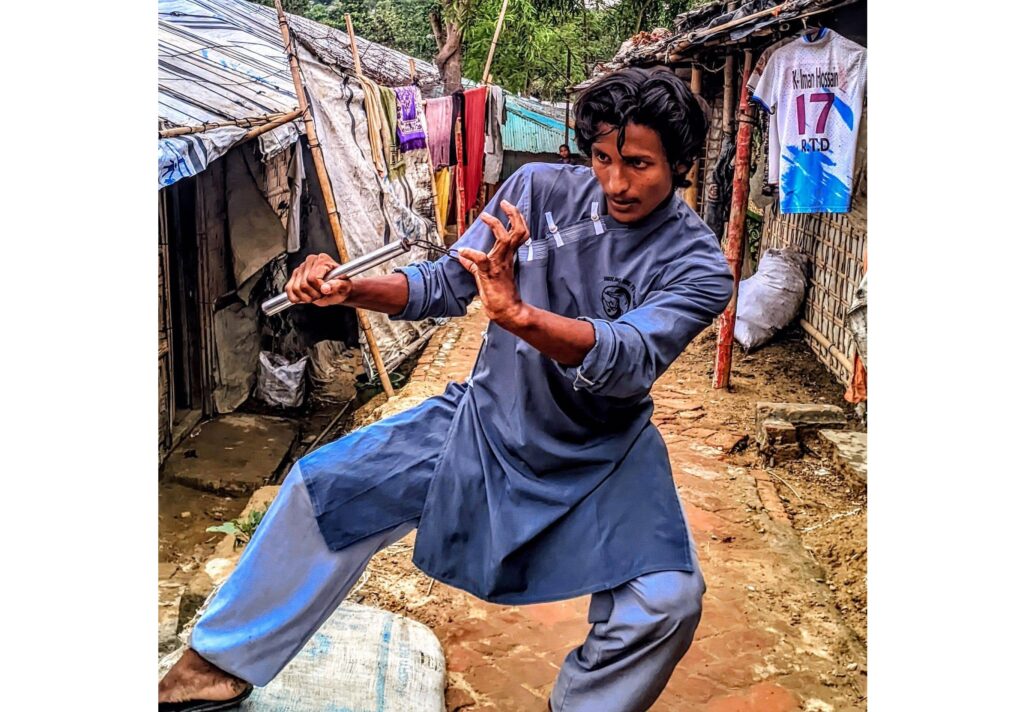
In the Rohingya refugee community in Bangladesh, a young man trains in martial arts with an ambition that seems much larger than the boundaries surrounding him. He practises kung fu, performs rapid movements, trains with nunchaku and shares videos of his performances on social media. His name is Mohammed Imran Khan, but online he has adopted a more memorable identity: the “Rohingya Bruce Lee.”
At first glance, his story may appear to be simply about a young refugee fascinated by the legendary Bruce Lee. But there is a deeper meaning behind it. Imran’s story raises an important question about the future of the Rohingya: Can a community known to the world mainly through persecution, statelessness and refugee camps gradually become known also through the achievements of its people?
The question matters because the Rohingya face not only a humanitarian and political crisis, but also a profound crisis of identity and belonging.
For generations, the Rohingya have lived in Myanmar’s Rakhine State, yet most have been denied citizenship and recognition as members of the country’s national community. The violence of 2017 forced more than 700,000 Rohingya to flee to Bangladesh, joining earlier waves of refugees. Today, Bangladesh hosts around one million Rohingya refugees.
Bangladesh deserves international recognition for providing shelter at a moment of extraordinary humanitarian crisis. But Bangladesh understandably maintains that permanent integration cannot be the solution to a problem originating in Myanmar. Third-country resettlement, meanwhile, remains available to only a small proportion of the refugee population.
The result is an extraordinary predicament. The Rohingya possess a strong collective identity, yet they have no state that fully accepts responsibility for them.
For young Rohingya, this creates an even deeper question: Who am I, and what can I become?
A child growing up in a refugee camp may have no memory of Myanmar. Bangladesh is the country he or she knows, yet it is not formally home. Opportunities to travel, study at university or enter professional employment remain extremely limited.
Statelessness therefore affects more than legal status. It can shape imagination itself.
The international community generally encounters the Rohingya through images of suffering; overcrowded camps, burnt villages, desperate boat journeys, food distribution centres and humanitarian appeals.
These images reflect genuine realities and must not be ignored. Yet there is an unintended consequence when an entire people become visible almost exclusively through their suffering.

A Rohingya child becomes a “refugee child.” A young man becomes a “refugee youth.” A woman becomes a “refugee woman.”
Gradually, the refugee label can overshadow the individual.
The Rohingya are then viewed primarily as people who need food, shelter and protection rather than as individuals capable of producing knowledge, creating businesses, excelling in sport, writing books, conducting scientific research or contributing to wider society.
This is where the story of the “Rohingya Bruce Lee” becomes interesting.
Available social-media material identifies the young martial artist as Mohammed Imran Khan, a Rohingya originally associated with Maungdaw Township in Rakhine State. Some details of his early biography remain difficult to independently verify, and therefore should be treated cautiously.
What is clear is his determination to present himself through martial arts.
Through repeated training and social-media performances, Imran has created an identity based not simply on what happened to his community, but on something he can do.
Even more significantly, he calls himself the “Rohingya Bruce Lee.” He does not hide the word Rohingya. He places it at the centre of his public identity. Implicitly, his message seems to be: I am Rohingya, but being a refugee does not define everything that I am.
Technology makes this possible in an interesting way. Physically, a refugee may face severe restrictions on movement. Yet a video made inside a refugee settlement can travel across the world within seconds.
The camp has geographical boundaries. His digital identity does not face the same boundaries.
This leads to a larger question.
Where are the internationally recognised Rohingya scientists, physicians, engineers, university professors, researchers, footballers, writers, entrepreneurs and artists?
The question should never be interpreted as suggesting that the Rohingya lack talent. Rather, it exposes the absence of opportunity.
A scientist needs schools, universities, laboratories and mentors.
An athlete needs playgrounds, coaches, nutrition and competition.
A researcher needs higher education, books, academic networks and opportunities to publish.
An entrepreneur needs legal identity, mobility, capital and access to markets.
Remove these structures from almost any population for generations and enormous amounts of human potential will remain invisible.
This is precisely why education is so important. Recent UN reporting from Bangladesh presents a disturbing picture. A large majority of Rohingya youth lack adequate access to education, while many young people feel that they have little opportunity to contribute meaningfully to their communities.
This is not merely a humanitarian concern. It is a question about the future of an entire generation.
Every community needs role models. Imagine a Rohingya scientist making an important discovery, a Rohingya physician contributing to global health, a Rohingya researcher presenting at an international conference, or a Rohingya athlete competing at the highest level.
Imagine what such achievements would mean to a twelve-year-old child in a refugee camp.
The message would be powerful:
Your circumstances are difficult, but they do not determine the limits of your potential.
Successful individuals cannot solve the Rohingya crisis. But they can change perceptions.
A Rohingya professor at a respected university becomes more than an academic. A Rohingya athlete competing internationally becomes more than a sportsman or sportswoman. A Rohingya author becomes more than a writer.
They become alternative representations of a community too often represented only through displacement.
Over time, hundreds of such individual stories could contribute to a different collective image.
There is, however, an important distinction. The Rohingya should not have to become doctors, scientists or famous athletes to prove that they deserve citizenship, security or human dignity.
These are fundamental rights.
Myanmar’s responsibility towards the Rohingya cannot be reduced because the community lacks internationally famous personalities. Nor should humanitarian protection depend upon whether refugees demonstrate exceptional talent.
The argument is different.
Education and achievement provide agency, confidence, representation and voice.
For a stateless community, these are enormously important assets.
The objective should therefore not simply be to “improve the Rohingya image.” It should be to create the conditions under which Rohingya individuals can develop their abilities and represent themselves.
Bangladesh cannot reasonably be expected to resolve alone a crisis created through decades of persecution and exclusion in Myanmar. Sustainable resolution ultimately requires conditions for voluntary, safe and dignified return with rights and security. But until such a solution becomes possible, a generation of Rohingya children is growing up.
It must also be given opportunities to develop. International donors, UN agencies, universities, sporting organisations and humanitarian actors should therefore treat human-capital development as an essential part of the refugee response. This means stronger secondary education, vocational training, digital learning, scholarships, university pathways, sporting facilities, arts programmes, research opportunities and leadership development.
Special attention must be given to Rohingya girls and young women. A community cannot realise its potential while half of its young people face additional barriers to education and professional development.
Importantly, developing Rohingya human capital does not have to contradict repatriation.
A doctor can return to Rakhine.
An engineer can return.
A teacher can return.
A researcher can return.
Indeed, if circumstances eventually permit sustainable repatriation, educated and professionally capable Rohingya will be essential for rebuilding their own communities.
The Rohingya community itself also has a role. Families and community leaders should encourage education, sport, science, technology, literature and entrepreneurship. Successful members of the Rohingya diaspora can mentor younger people. Rohingya professionals abroad can establish scholarships and educational networks. Most importantly, young Rohingya need to see examples of people from their own community succeeding through knowledge, discipline and creativity.
A hundred Rohingya success stories would begin changing perceptions.
Thousands of educated and skilled Rohingya would begin changing the future of the community itself.
Mohammed Imran Khan may or may not eventually become a professional martial artist. His online popularity may increase or fade. That is not the most important aspect of his story.
Here is a young Rohingya trying to be recognised not simply for belonging to a persecuted population, but for a skill he has worked to develop.
Now imagine many more.
A Rohingya physicist.
A Rohingya surgeon.
A Rohingya footballer.
A Rohingya professor.
A Rohingya entrepreneur.
A Rohingya novelist.
A Rohingya peacebuilder.
And thousands of teachers, technicians, nurses, engineers and skilled professionals whose names may never appear in newspapers but whose contributions could transform their communities.
The political solution to the Rohingya crisis must still address citizenship, rights, security and their future in Myanmar. Individual achievement cannot substitute for political responsibility. But political negotiations may take years. Human potential cannot be placed on hold while diplomacy searches for a solution.
The world already knows the Rohingya as survivors of persecution. It is time to create the opportunities through which the next generation can also become known as scientists, athletes, researchers, doctors, teachers, entrepreneurs, artists and contributors to the wider world.
Perhaps that is the larger significance of the young man who calls himself the “Rohingya Bruce Lee.”
He is not the solution to the Rohingya crisis. But he represents something the Rohingya community desperately needs; the possibility of being known not only for what it has suffered, but also for what its people can become.
For More Info Click Here.
Follow Our Facebook Page From Here.
Subscribe Our Youtube Channel quickly.